
office plant rental comparison
For facility managers and finance leaders, an office plant rental comparison should measure the full workplace program, not only the first invoice. Design, installation, care, replacements, employee time, and contract terms all shape the business case. A narrow comparison that looks exclusively at retail plant prices against monthly lease fees will miss the operational realities of keeping plants healthy in a commercial environment. Plants that fail within weeks, staff hours redirected from core responsibilities, and unplanned replacement purchases can shift the math significantly over a 12- or 36-month period.
For companies in the Office Plants service area, the right choice depends on the workplace, available staff, light conditions, and preferred budget structure. A 50-person open-plan office in San Jose with abundant natural light has different requirements than a 200-person call center in Sacramento with primarily artificial illumination. This comparison gives decision-makers a structured framework for evaluating both paths with real numbers, real responsibilities, and real service expectations.
Key Takeaways
- Leasing office plants moves design, installation, and ongoing care responsibilities to the provider, reducing demands on your internal team and producing predictable monthly costs.
- Buying plants requires a larger upfront payment but eliminates recurring rental costs, which can suit organizations with stable budgets, horticultural knowledge, and dedicated maintenance staff.
- The full cost of a plant program includes hidden expenses such as employee time for watering, soil cleanup, pest treatment, fertilizer, and replacement plants, not just the initial purchase or lease price.
- Contract terms in a lease agreement typically include scheduled replacements and professional care, which can extend plant life and keep the workplace looking fresh throughout the contract term.
- A site-specific proposal based on actual light readings, traffic patterns, and facility constraints produces more accurate cost projections than generic package pricing.
Why Office Plant Leasing Makes Sense for Bay Area Businesses
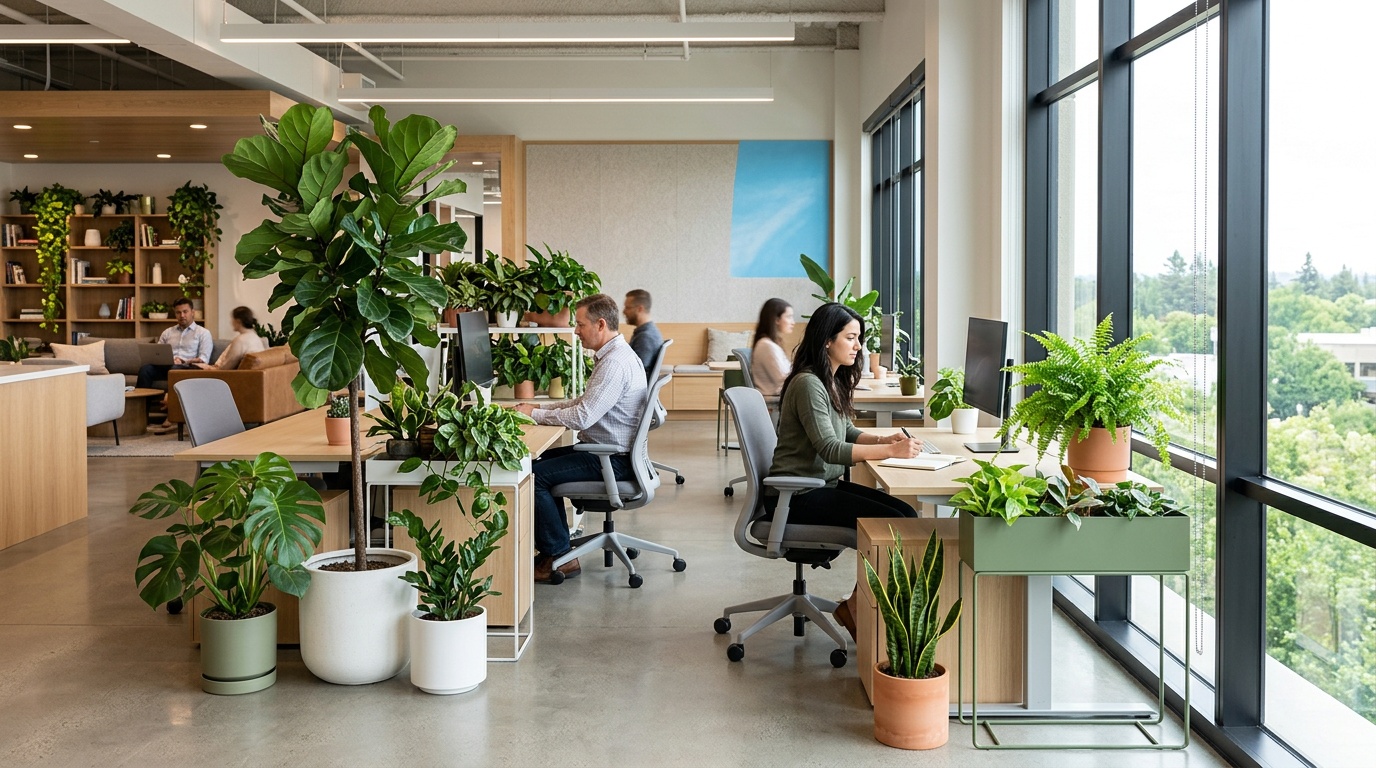
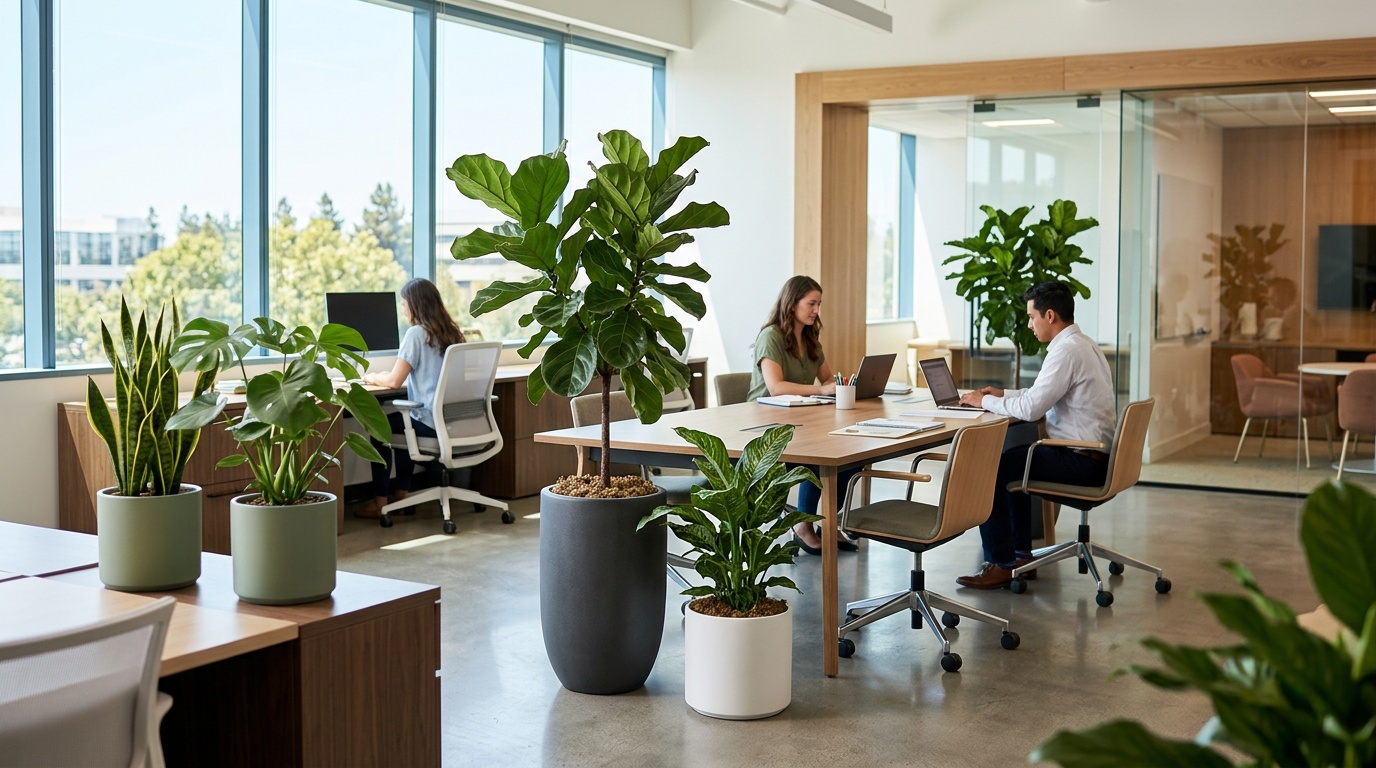
Office plant leasing gives a business a professionally designed display while assigning routine care to a commercial service team. During a free on-site assessment, we review light, circulation, access, and the building’s visual priorities before installation. That planning helps facility teams avoid unsuitable species, awkward placement, and unplanned maintenance work. A common scenario involves a company purchasing a large Ficus lyrata for a reception area with limited natural light, only to find the plant dropping leaves within four to six weeks. A pre-installation light assessment and species consultation can prevent that outcome entirely.
Custom interior plant design and installation can define reception areas, conference rooms, open workspaces, and employee common areas. The business benefit is a maintained workplace presentation with a service scope that is easier to budget than a series of unplanned purchases. When a company leases, the monthly fee covers not only the plants and containers but also the design expertise that ensures each species matches its location. This approach reduces the trial-and-error pattern that many offices experience when staff members buy plants from retail nurseries without understanding the specific demands of commercial indoor environments.
Suitable species and containers can serve low-light or windowless areas when selected for the actual conditions. Our team uses its office plant selection and low-light recommendations to match each zone, then documents the care plan in the custom design proposal. Sansevieria, Zamioculcas zamiifolia, and certain Aglaonema varieties perform reliably in interior offices with fluorescent lighting, while bright lobby spaces may support Bird of Paradise or large Dracaena specimens. The key is matching plant biology to measured conditions rather than aesthetic preference alone.
Beyond visual considerations, leasing provides a structural advantage for busy Bay Area workplaces. High employee turnover, shifting department layouts, and renovation projects can leave purchased plants orphaned in unsuitable locations. A leasing arrangement allows the service provider to reposition, swap, or replace specimens as conditions change, keeping the plant program aligned with the facility rather than locked into a one-time purchase decision made months or years earlier.
Buying Plants vs. Leasing: A Total Cost Comparison
Buying can appear less expensive when a budget review considers only the first invoice. A 6-foot Dracaena marginata from a retail nursery might cost $240 to $360, and an administrative assistant may assume that watering once a week is sufficient. The full cost picture is quite different. The complete expenditure may include decorative containers at $80 to $240 each, delivery fees of $50 to $150, installation labor if the plant is large, a moisture meter or watering schedule, replacement plants when specimens fail, pruning tools, pest treatment products, fertilizer, soil amendments, and the value of employee time spent on these tasks.
When those secondary costs accumulate over a year, the gap between buying and leasing narrows considerably. A mid-sized office that purchases 15 plants at an average of $180 each has spent $2,700 before containers, delivery, or any maintenance supplies. If four plants die and need replacement within six months, the replacement cost adds another $720 or more. Employee time spent watering, cleaning leaves, diagnosing problems, and shopping for replacements can represent 20 to 40 hours annually, depending on the number of plants and the skill level of the person assigned.
Leasing creates a recurring service arrangement, so the proposal and contract should define exactly what the business receives. A typical monthly lease fee covers the plants, containers, installation, scheduled maintenance visits, and replacement guarantees. The predictable monthly expense simplifies budgeting and removes the risk of surprise costs when a plant declines or a pest issue surfaces. The table below summarizes the core comparison points:
| Consideration | Buying plants | Leasing plants |
|---|---|---|
| Upfront cost | Purchase of plants, containers, delivery, and installation paid in full before placement | Initial setup fee and monthly service rate established in the proposal |
| Ongoing care | Managed internally by assigned staff or arranged separately with a third party | Professional care visits included, with watering, pruning, cleaning, and health monitoring |
| Replacement exposure | Business carries full replacement cost and shopping responsibility | Provider handles replacement at no additional charge within contract terms |
| Design flexibility | Changes require new purchases and potentially disposal of existing plants | Placement, species, and containers can be reviewed as workplace needs change |
| Budget profile | Irregular costs tied to plant health issues and replacement timing | Consistent monthly rate that simplifies departmental and annual budgeting |
| Staff time required | Estimated 20 to 40 hours annually for a mid-sized plant program | Minimal staff involvement beyond providing building access |
| Pest and disease management | Office staff must identify problems, source treatments, and apply products | Trained technicians monitor and treat issues during scheduled visits |
Finance leaders should also consider the time value of their facilities team. When an office manager spends 30 minutes each week checking plants, mixing fertilizer, and cleaning up spilled water, that time comes at the expense of other priorities. Over a 50-week year, that equals 25 hours, which at a loaded labor rate of $40 to $60 per hour represents $1,000 to $1,500 in indirect cost, a figure rarely captured in a purchase-versus-lease analysis.
Maintenance Responsibilities and Plant Replacement Terms
Ownership can work for a business with assigned staff, horticultural knowledge, and time for routine inspections. Those duties include checking soil moisture with a meter or finger test, wiping dust from foliage to keep leaf pores functioning, pruning dead or yellowing growth, rotating containers for even light exposure, monitoring for spider mites and scale insects, treating infestations before they spread to nearby plants, fertilizing on a seasonal schedule, and identifying declining specimens before they affect the office presentation. Ongoing maintenance belongs in the financial comparison from the start, and it should be quantified rather than assumed.
With leasing, businesses should ask who handles scheduled care, how service continuity is managed during staff transitions at the provider, and what happens when a location or species performs poorly. Office Plants’ sustainable plant maintenance and guaranteed replacement program includes recurring professional care and plant replacement support, as specified in the written service terms. Our trained technicians visit on a defined schedule, typically every one to two weeks depending on the plant count and species mix. They bring their own supplies, document the condition of each plant, and flag any environmental concerns such as HVAC changes or construction dust that could affect plant health.
Replacement policies deserve close attention in any comparison. When a purchased plant dies, someone on the internal team must notice the problem, remove the dead plant, select a replacement, place an order, arrange delivery, and install the new specimen. That cycle can take two to four weeks, during which the workplace has an empty container or a visibly declining plant. Under a leasing arrangement with a replacement guarantee, the service technician identifies the problem during a routine visit and schedules a replacement, often within the next one to two service cycles. The visual continuity of the workspace is preserved without requiring any action from office staff.
Research on indoor plants and workplace environments provides context for evaluating how plant presence may relate to indoor occupant experience. Studies have examined outcomes such as reported satisfaction, perceived air quality, and psychological comfort in planted versus unplanted workspaces. The practical question is how that potential benefit fits your facility’s goals, staffing plan, and budget. If the objective is a polished reception area that makes a strong first impression on clients and candidates, a professionally maintained program delivers more consistent results than a self-managed collection of retail purchases.
The strongest comparison is specific to the workplace: plant count, container style, light conditions, access requirements, service frequency, and contract provisions. A free on-site assessment lets us prepare a custom proposal based on the facility rather than an assumed package. During the assessment, we take light readings at potential placement locations, measure floor space and ceiling clearance for large specimens, note traffic patterns that could damage fragile plants, and discuss brand preferences for container finishes and overall design direction. This level of specificity produces a proposal you can evaluate alongside a purchase scenario with confidence.
How Our Plant Rental Program Works: A Step-by-Step Guide
For a commercial workplace, a successful rental program begins with an on-site assessment rather than a generic package. Office Plants reviews the building, occupants, light exposure, access, watering logistics, and planned changes before preparing a custom design proposal. The process connects plant selection to the way your business operates and establishes the maintenance plan before installation. Each step is designed to eliminate guesswork and ensure the plants placed in your facility have the best possible chance of long-term health.
- Assess the workplace: We walk through your facility with a qualified designer who measures light levels at each potential placement area using a lux meter. We document ceiling heights, HVAC vent locations, window orientation, floor traffic, security access requirements, and any upcoming construction or renovation plans. We also discuss your brand aesthetic, color preferences, and any specific areas where leadership wants a visual focal point.
- Develop the design: Based on the assessment data, we match plant forms, container finishes, hanging features, and living wall concepts to each zone. Low-light corridors receive shade-tolerant species like Pothos or Cast Iron Plant, while bright lobbies may feature statement specimens such as Kentia Palm or large Monstera. Container finishes are selected to complement your interior finishes, whether that means matte black cylinders for a technology office or warm terra-cotta tones for a wellness brand. Custom designed photos are included with each proposal so you can visualize what each plant recommendation will look like specifically in your facility.
- Confirm the proposal: We present a written proposal that specifies plant species, container sizes and finishes, quantities for each zone, installation date, maintenance schedule, monthly fee, and contract duration. You review the scope, request adjustments if needed, and approve the final plan before any plants are ordered or delivered. There are no surprise charges or unspecified add-ons.
- Schedule delivery: Once the proposal is approved, we coordinate delivery around your operational schedule, which may mean early morning or weekend installation for facilities that cannot accommodate daytime disruption. Our team brings protective materials for floors and walls, places each plant according to the approved design, sets up any sub-irrigation systems, and confirms that containers are level and stable.
- Begin care: Within the first week after installation, our technician performs the first maintenance visit. They check soil moisture calibration for each species, inspect for any shipping stress, adjust placement if a plant shows signs of light sensitivity, and establish the regular service cadence. Subsequent visits follow the agreed schedule, with detailed attention to each specimen.
The entire process typically takes two to three weeks from the initial consultation to installation day, depending on plant availability and the complexity of the design. For larger projects involving multiple floors or specialized installations such as living walls, the timeline may extend to four to six weeks to allow for custom container fabrication and species sourcing.
How to Evaluate a Commercial Plant Service Provider
A provider comparison should focus on operational fit, not the number of species in a catalog. A company with 200 plant varieties in its portfolio but no documented service protocol may deliver less consistent results than a provider with 40 carefully selected species and a rigorous maintenance schedule. Ask for written details about maintenance tasks, response procedures, replacement terms, installation responsibilities, and communication channels. A clear scope prevents unexpected work from falling to your facilities team.
- Commercial experience: Does the provider routinely serve offices, medical buildings, hotels, and other commercial organizations? Residential plant services may not understand the logistics of servicing a building with badge access, loading dock restrictions, or after-hours security requirements. Office Plants has served commercial clients exclusively since 1994, and our technicians are familiar with the operational rhythms of corporate environments.
- Site assessment: Will a qualified designer inspect light, airflow, access, and circulation before proposing a plant list? A provider that quotes pricing over the phone without seeing the space is guessing, and those guesses lead to plant failures. A proper assessment includes light measurements, traffic pattern analysis, and a discussion of how each area is used by employees and visitors.
- Care schedule: Does the agreement define watering frequency, pruning standards, foliage cleaning methods, pest monitoring protocols, and quarterly health checks? Ask whether the same technician visits your site each time or whether you will see rotating staff. Consistency matters because a technician who knows your plants can spot subtle changes early.
- Replacement terms: What happens when a plant becomes unattractive, damaged, or unsuitable for its location? Is the replacement included in the monthly fee, or is it billed separately? Are there exclusions for damage caused by building issues such as water leaks or construction? Read the replacement clause carefully and ask for clarification on any ambiguous language before signing.
- Design flexibility: Can the business request changes to containers, placement, or applications during the contract term? If your company rebrands, moves departments, or renovates a space, will the provider accommodate container swaps or new plant additions at a reasonable cost? The best providers treat the plant program as an evolving element of the workplace, not a static installation.
- Scope clarity: Are delivery, installation, maintenance, replacements, and eventual removal described as separate line items or bundled into a single monthly fee? Bundled pricing is simpler for budgeting, but you should still receive a clear breakdown of what is included. Ask whether fertilizer, pest treatment products, and replacement soil are covered or billed as extras.
Finance teams assessing the purchase side of an office plant program may also review the budget implications of property and equipment treatment with their tax adviser. Depreciation schedules, capital versus operating expense classification, and lease accounting standards can all influence whether a purchase or lease structure is more advantageous for a particular organization. These considerations vary by entity type and financial situation, so consult a qualified professional before making a final determination.
Evidence about the benefits of indoor plants may also help teams consider indoor environmental quality when comparing workplace options. Research published in peer-reviewed journals has examined connections between planted workspaces and metrics such as reported stress levels, attendance patterns, and self-reported productivity. While individual results vary by workplace and study methodology, the growing body of literature supports the proposition that plants are a worthwhile investment in the physical work environment.
References
Frequently Asked Questions About Renting Office Plants
What does plant rental maintenance include?
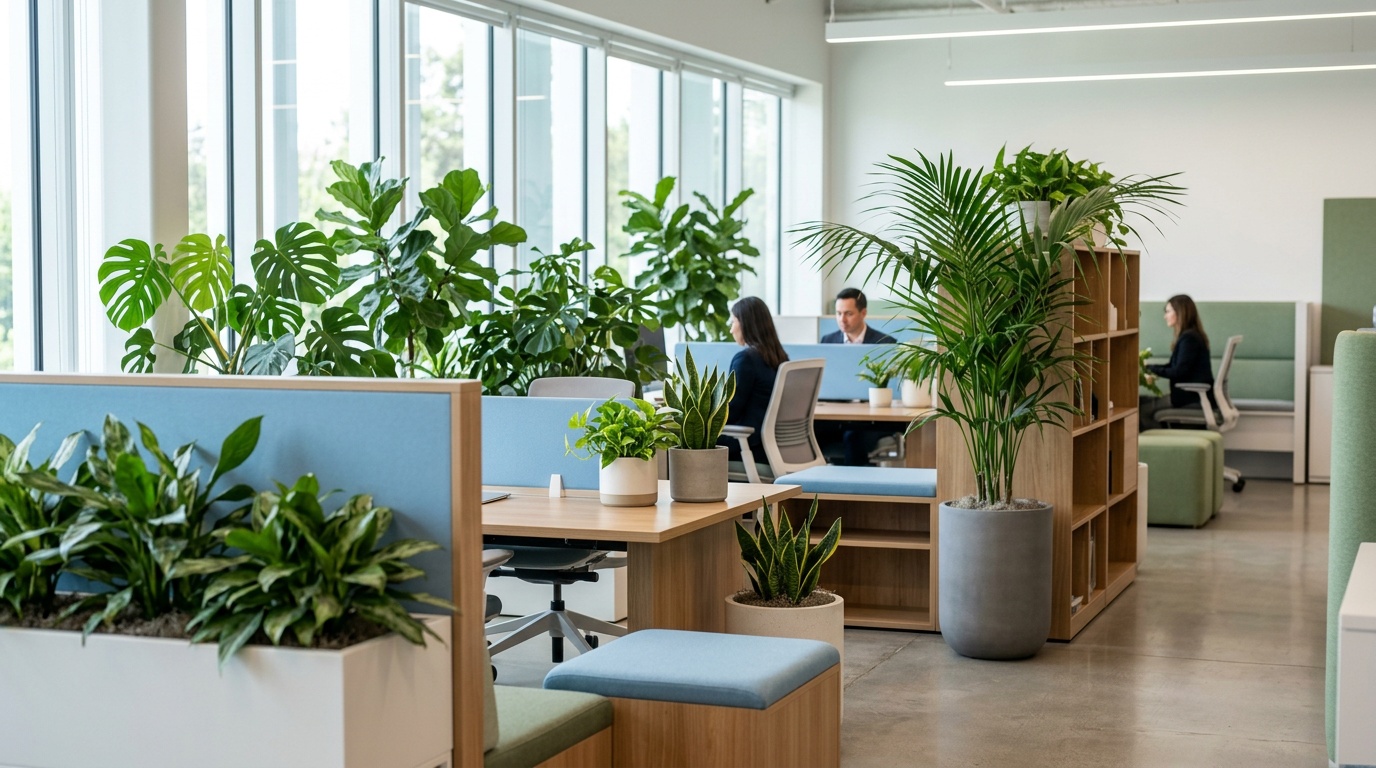
Plant rental maintenance typically covers a comprehensive set of tasks performed by trained horticultural technicians during scheduled service visits. These tasks include soil moisture checks using professional meters, calibrated watering tailored to each species and container size, foliage cleaning to remove dust that blocks photosynthesis, pruning of dead or yellowing leaves, insect and mite inspection, damaged-leaf removal, fertilizer application on a seasonal schedule, and review of planters and surrounding surfaces for water damage or soil debris.
Technicians also assess environmental conditions that may affect plant health, such as changes in HVAC output, new construction dust, relocated light fixtures, or seasonal shifts in window light. If a plant is struggling, the technician documents the issue, adjusts care, and may recommend relocation or replacement. The exact scope depends on the service agreement, so businesses should request a written task list before signing.
What happens if a rented plant dies or looks unhealthy?
Under a standard leasing arrangement, the service team takes responsibility for identifying why a plant is declining and determining the appropriate response. That process begins during a routine maintenance visit, when the technician notes symptoms such as leaf drop, yellowing, wilting, or pest activity. The technician evaluates whether the issue stems from light levels, watering frequency, temperature fluctuations, drafts, or a pest problem, then decides whether repositioning, adjusted care, pruning, or full replacement is the best course of action.
Businesses should review the replacement guarantee carefully before signing the contract. Key questions include: How quickly is a replacement scheduled? Are there any exclusions for damage caused by building issues, employee actions, or construction? Is there a limit on the number of replacements per year? Office Plants provides replacement support as part of its standard service terms, ensuring that your workspace always looks complete and professional.
Can I change or swap plants during my rental contract?
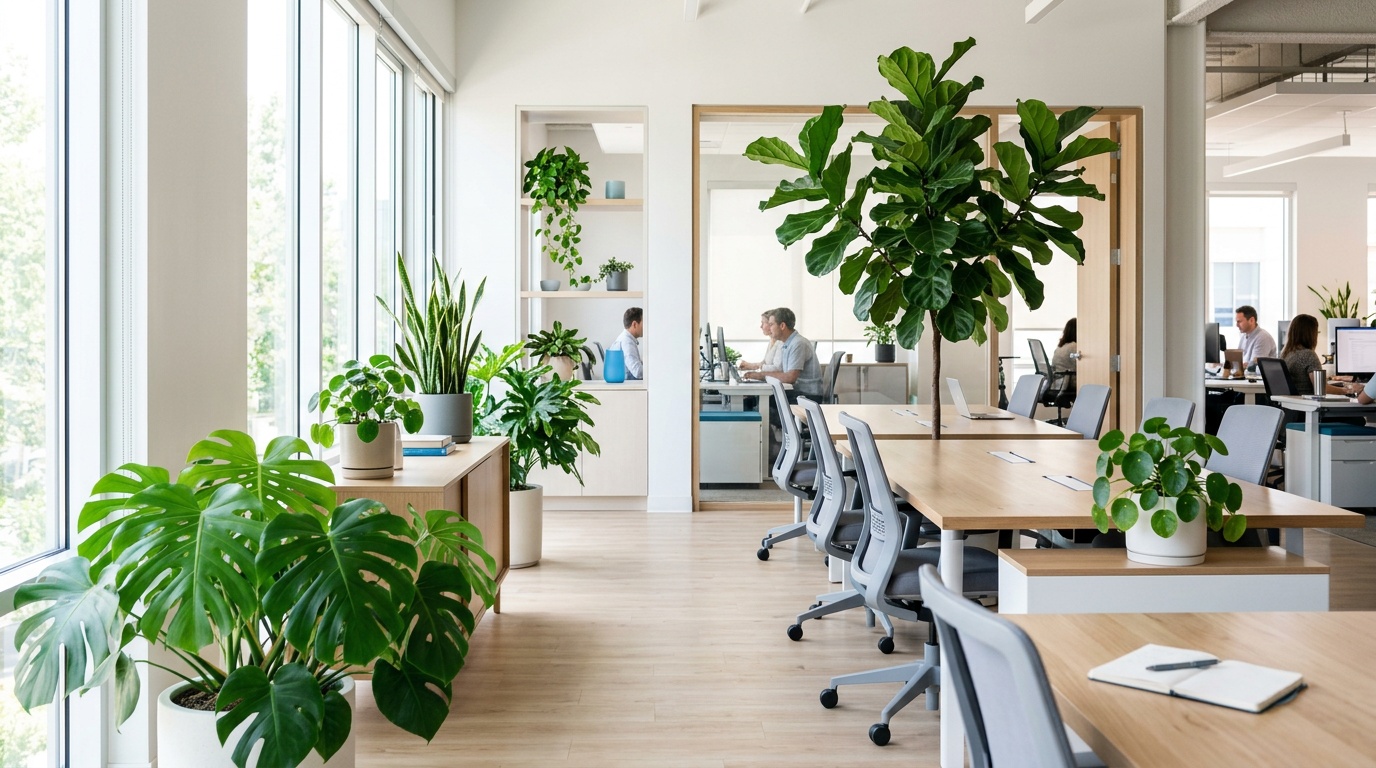
Plant swaps are generally available when a business changes its floor plan, renovates a reception area, relocates departments, or wants a different visual direction. A growing company may add plants to accommodate new hires in a previously unused section of the building, or a design refresh may call for updated container finishes. The leasing model is built to accommodate these changes because the provider owns the plants and can reposition or exchange them as needed.
Contract flexibility varies by provider and agreement type, so ask specifically whether the contract permits seasonal refreshes, location changes, container updates, or species substitutions. Some agreements include a set number of complimentary swaps per year, while others charge a modest fee for additional changes. Understanding this flexibility before signing helps you avoid surprises when your workplace needs evolve.
When are plant rentals right for my office?
Renting may suit a business that wants a professional plant display without assigning daily care to office staff. Companies that prioritize a consistent visual presentation for client-facing areas, that lack internal staff with horticultural knowledge, or that prefer predictable monthly expenses over irregular replacement costs are strong candidates for leasing. The model also works well for organizations that expect growth, relocation, or renovation, since the plant program can scale and adapt with the business.
Buying may suit an organization with dedicated maintenance personnel, stable premises, a long-term commitment to the same location, and a willingness to manage replacements, pest issues, and design changes internally. Some businesses adopt a hybrid approach, purchasing a few statement plants for a permanent lobby installation while leasing plants for flexible work areas. A consultation can help you determine which structure aligns with your facility, staffing, and financial priorities.
Businesses in Office Plants’ approved service area can discuss leasing or purchase options during a free on-site consultation. We then prepare a custom proposal based on staffing, facility access, budget structure, contract duration, and desired service accountability. Every recommendation is grounded in the specific conditions of your workplace, not a generic template. To confirm availability and schedule your assessment, request a free on-site consultation.