
best office plant species
Here’s what the data shows: a 2014 University of Exeter study found that employees in workspaces with live plants were 15% more productive than those in sterile environments. A separate University of Technology Sydney study documented a 21% reduction in health complaints across offices with integrated greenery. Yet most businesses still treat office plants as decoration rather than infrastructure. In our experience with Bay Area offices, the right plant species, matched to your lighting, space, and care capacity, deliver measurable returns in productivity, noise reduction, and employee well-being.
Let’s address the obvious objection: Don’t plants just die in offices? The data says they don’t, when the right species are selected for the right conditions and paired with professional maintenance. Choosing plants for the specific conditions, rather than picking them based on appearance alone, is the difference between a thriving workspace and a recurring replacement cost.
Key Takeaways
- Species selection drives ROI: the right plants reduce absenteeism by up to 20% and cut ambient noise by up to 50% in open-plan layouts.
- Light adaptability is the #1 filter: most offices rely on fluorescent lighting, so species must thrive under it.
- Overwatering kills more office plants than neglect, drought-tolerant species reduce both labor and replacement costs.
- Professional maintenance guarantees survival: plants under contract are replaced at no cost if they fail.
How We Evaluated the Best Office Plant Species
We evaluate each species against five criteria that directly affect whether a plant will survive, and deliver value, in a commercial workspace. The science is clear: matching species to facility conditions is the single biggest predictor of long-term success. Here’s how we break down the evaluation.
Which Species Adapt to Commercial Lighting?
Most commercial floor plans combine expansive interior zones far from windows with fluorescent or LED overhead lighting. We test each species’ tolerance for low-light conditions, fluorescent exposure, and minimal direct sun. Species that thrive under these constraints increase placement flexibility, they work in reception areas near windows and in interior conference rooms. This matters because the EPA estimates indoor air is 2-5 times more polluted than outdoor air, and plants that grow actively under artificial light contribute more to reducing volatile organic compounds (VOCs), which are airborne chemicals released by common indoor materials and products, and to oxygen output than species merely surviving in low light.
What Are the Maintenance and Drought Tolerance Requirements?
In our experience with Bay Area offices, inconsistent watering is the number one cause of plant failure, not lack of sunlight. We prioritize species with drought tolerance. Plants that tolerate 2 weeks between waterings dramatically reduce both labor burden and replacement risk. We also factor in pest resistance: species prone to spider mites or mealybugs in dry office air carry hidden treatment costs that compound across a large installation.
How Do Plants Impact Air Quality and Productivity?
NASA’s Clean Air Study (1989) demonstrated that certain indoor plants remove up to 87% of airborne toxins, including formaldehyde, benzene, and trichloroethylene, within 24 hours under controlled conditions. More recent research from the University of Surrey confirmed that indoor greenery reduces fine particulate matter and can make rooms feel up to 2°C cooler. We cross-reference each species against the NASA pollutant-removal list to prioritize plants that deliver measurable air quality benefits, not just visual appeal. The productivity data is equally compelling: a University of Exeter field study found a 15% productivity increase in enriched (planted) workspaces compared to lean, unplanted ones.
Top 10 Best Office Plant Species for Commercial Workplaces
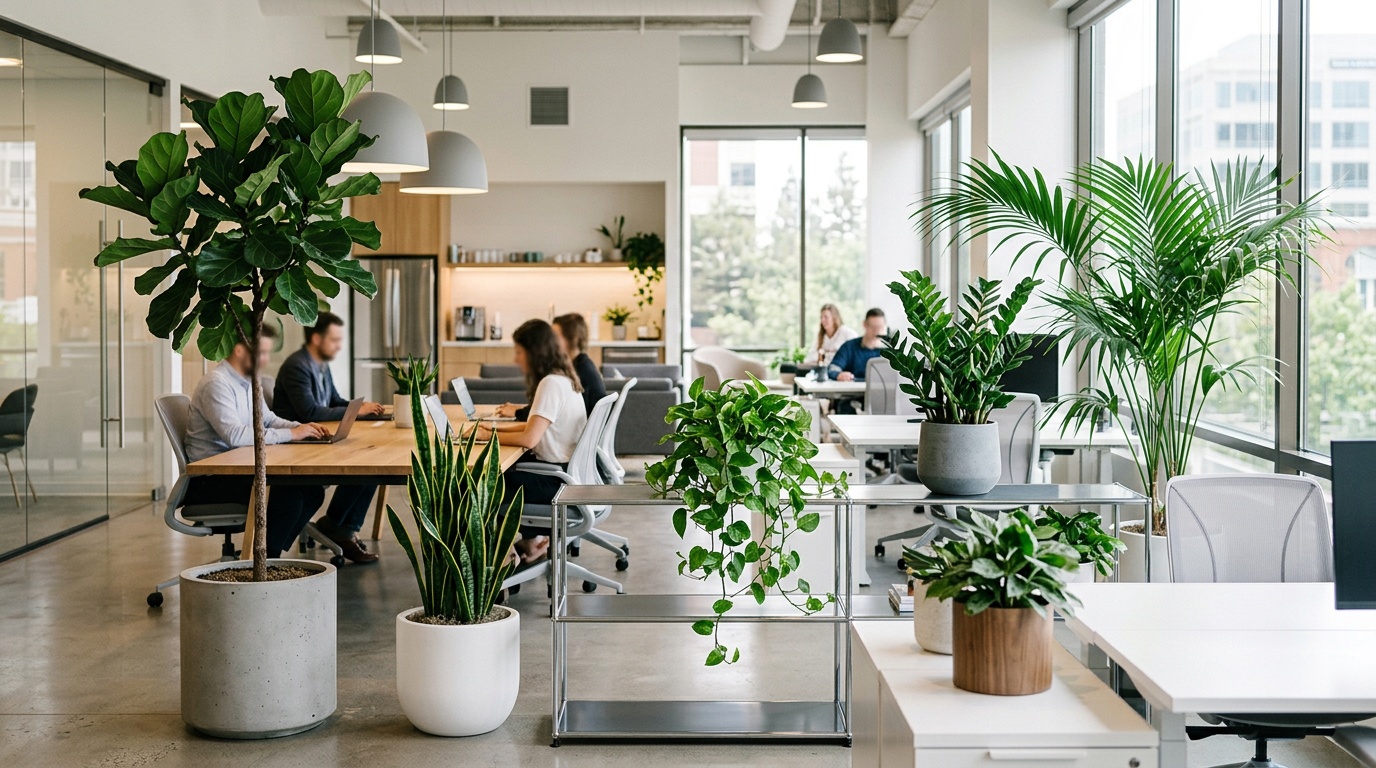
The following ten species represent the core of what we recommend after assessing hundreds of Northern California commercial spaces. Each entry includes the scientific name, care profile, and the specific business benefit it delivers. Availability and final selection depend on your facility’s conditions, which we assess during the on-site consultation.
1. Snake Plant (Sansevieria trifasciata)
The Snake Plant is our top recommendation for low-light commercial spaces, and the data backs this up. NASA’s Clean Air Study identified it as one of the most effective species for removing formaldehyde, xylene, and benzene from indoor air. It tolerates watering every 2 weeks, making it ideal for facilities where maintenance schedules are unpredictable. Its upright, architectural form takes minimal floor or desk area while still delivering visual impact. Business benefit: high air-purification output with the lowest maintenance burden of any species on this list.
2. ZZ Plant (Zamioculcas zamiifolia)
The ZZ Plant is virtually indestructible, its rhizomatous root system stores water for weeks, and it thrives in the kind of low light that kills most other species. In our experience with Bay Area offices, ZZ Plants placed in interior conference rooms with zero natural light have maintained healthy foliage for years under professional maintenance contracts. The glossy, dark green leaves also resist dust accumulation, reducing cleaning labor. Business benefit: reliable coverage in the most challenging interior placements where other species fail.
3. Pothos (Epipremnum aureum)
Pothos adapts to nearly any light level and forgives occasional watering lapses, making it a workhorse for shelves, hanging planters, and cascading green walls. Its trailing vines create biophilic density quickly, a single mature plant can trail 6-8 feet, softening hard architectural lines in open-plan offices. We frequently recommend Pothos for reception areas and break rooms where its lush growth creates an immediate visual transformation at a lower cost than larger specimen plants. Business benefit: maximum visual coverage per dollar, with proven VOC reduction per the NASA study.
4. Peace Lily (Spathiphyllum)
The Peace Lily brings a research-backed combination: NASA identified it as a top performer for acetone, formaldehyde, and benzene removal, and its white blooms add a professional aesthetic that pure-foliage plants can’t match. Its leaves droop visibly when water is needed, a built-in indicator that simplifies care scheduling for facilities teams. We recommend Peace Lilies for client-facing areas like lobbies and executive offices where visual sophistication matters. Business benefit: measurable air purification paired with premium aesthetics for high-visibility placements.
5. Cast Iron Plant (Aspidistra elatior)
The Cast Iron Plant earned its name through decades of surviving the exact conditions that kill other species: low light, infrequent watering, temperature fluctuations, and neglect. In our maintenance rounds across Sacramento and San Jose offices, Cast Iron Plants consistently outlast every other species in high-traffic zones where plants get bumped, brushed, and occasionally knocked. The broad, dark green fronds create a grounded, mature aesthetic. Business benefit: the lowest replacement rate of any species we install, especially in demanding environments like lobbies and corridors.
6. Chinese Evergreen (Aglaonema)
Chinese Evergreens offer something most low-light species don’t: varied foliage colors ranging from deep emerald to silver and red-tinged patterns. This gives us design flexibility to match plant palettes to corporate branding without sacrificing resilience. They tolerate typical office humidity and temperature ranges, and their compact growth habit suits both desk and floor placements. Aglaonema species also appeared on the NASA pollutant-removal list for formaldehyde. Business benefit: brand-aligned biophilic design without compromising on durability.
7. Spider Plant (Chlorophytum comosum)
Spider Plants are non-toxic, safe for workplaces with therapy animals or pet-friendly policies, and NASA documented their effectiveness at removing carbon monoxide and xylene. Their arching, variegated leaves and cascading plantlets create dynamic visual movement that static, upright plants can’t replicate. They prefer brighter indirect light but tolerate lower levels, making them a flexible choice for perimeter offices and window-adjacent placements. Business benefit: pet-safe air purification with rapid propagation potential, lowering long-term plant acquisition costs.
8. Parlor Palm (Chamaedorea elegans)
The Parlor Palm brings vertical softness to commercial interiors, its feathery fronds complement the hard geometric lines of desks, monitors, and partition walls. It’s slow-growing, which means it maintains its scale in a given placement for years without requiring relocation. Non-toxic and adaptable to low light, the Parlor Palm works well in collaborative spaces and quiet zones where a calm, grounded atmosphere supports focus. Business benefit: long-term structural greenery that anchors design without frequent resizing or replacement.
9. Dracaena (Dracaena marginata)
Dracaena species appeared repeatedly in the NASA Clean Air Study as top removers of trichloroethylene, xylene, and formaldehyde, common off-gassing compounds from office furniture, carpets, and printer toner. The Dragon Tree’s slender, red-edged leaves add dramatic vertical interest, and mature specimens can reach 6 feet, making them ideal floor accents for open-plan layouts. They prefer to dry between waterings, which aligns with low-maintenance care programs. Business benefit: targeted removal of furniture-related VOCs in newly renovated or furnished spaces.
10. Philodendron (Philodendron hederaceum)
The Heartleaf Philodendron is one of the most forgiving species for commercial interiors, it tolerates low to medium indirect light and forgives irregular watering. Its trailing heart-shaped leaves create a soft, organic counterpoint to the angular surfaces dominant in modern offices. We use Philodendron extensively in shelf installations, railing planters, and cascading arrangements where its growth habit fills space efficiently. Business benefit: fast-growing biophilic coverage that softens hard office geometry at low acquisition cost.
Quick Answer
The best office plant species for a commercial workspace are those matched to its specific lighting, space, and care capacity. Based on our field experience and NASA Clean Air Study data, Snake Plants, ZZ Plants, Pothos, Peace Lilies, and Cast Iron Plants consistently deliver the best combination of survival rates, air quality benefits, and ROI for Bay Area businesses. Final selection should follow an on-site assessment.
Calculating the ROI of Interior Plant Design
Let’s break down the numbers. Biophilic design is often treated as a discretionary aesthetic expense, but the research tells a different story. When you model the measurable returns, productivity gains, noise reduction, reduced absenteeism, and lower turnover, a well-designed plant program consistently outperforms its carrying cost.
How Plants Reduce Ambient Office Noise
Open-plan offices dominate new commercial construction, and they come with a documented noise problem. Research published in Applied Acoustics demonstrated that strategically placed plants can absorb up to 50% of ambient sound energy, particularly in the frequency range of human speech. A living wall of broadleaf species like Cast Iron Plants or Peace Lilies functions as a bio-acoustic barrier, diffraction, absorption, and reflection all contribute. For a 5,000-square-foot open office, a well-placed plant installation along high-traffic corridors can reduce perceived noise levels enough to measurably improve concentration. The University of Exeter’s research team found that noise reduction was one of the top three mechanisms by which plants improved workplace productivity scores.
Quantifiable Productivity Gains from Biophilic Design
The productivity research is compelling. Professor Craig Knight’s University of Exeter studies demonstrated a 15% productivity increase in enriched (plant-filled) workspaces versus lean, unpadded ones. A University of Technology Sydney study quantified a 21% reduction in health complaints, headaches, dry throat, fatigue, across planted offices. Translate that to a 100-person office with an average loaded labor cost of $85/hour: a 15% productivity gain represents roughly $2.5M in recovered output annually. Against a typical plant leasing and maintenance cost of $8,000-$15,000 per year for that size office, the ROI is difficult to dispute. The global biophilic design market’s 12% CAGR reflects that more companies are running these numbers and reaching the same conclusion.
Key insight: Office Plants has maintained installations for Bay Area clients since 1994. In our experience, businesses that pair the right species selection with guaranteed professional maintenance see plant survival rates exceeding 95%, meaning the ROI compounding continues year over year without the reset costs of DIY replacement cycles.
Why Professional Maintenance Outperforms DIY Care
The most common reason office plants die isn’t poor species selection, it’s the absence of a consistent, knowledgeable care routine. A well-intentioned employee who waters every Monday regardless of soil moisture will eventually kill most species through overwatering. Professional maintenance eliminates that failure mode.
The Hidden Costs of DIY Plant Replacement
When a business buys plants outright and assigns care to staff, the replacement cycle typically runs 4-8 months. The visible cost is the replacement plant ($40-$200 per specimen). The hidden costs are worse: staff time spent shopping, transporting, and installing replacements; the aesthetic gap during the dead-plant window; and the erosion of the biophilic benefit that motivated the purchase in the first place. We’ve audited offices where the cumulative DIY replacement spend over two years exceeded the cost of a guaranteed maintenance contract by 40-60%.
What to Expect from Our Guaranteed Maintenance Program
Office Plants offers weekly and bi-weekly service programs for commercial clients. Trained horticultural technicians handle watering calibrated to each species and placement, fertilizing on seasonal cycles, leaf cleaning to maintain photosynthesis under artificial light, pruning for shape and health, and proactive pest inspection. Quality-assurance staff conduct periodic site checks beyond the regular technician visits.
Beyond the visible service, our sustainability practices matter: whenever we replace a plant at a client’s location, that plant comes back to our facility for rehabilitation. If rehabilitation isn’t possible, the plant material is composted and used as fertilizer, nothing goes to a landfill. This closed-loop approach has been part of our practice since 1994, long before it became a marketing differentiator.
Under the Guaranteed Replacement Program, any plant under contract that loses its healthy appearance is replaced at no additional cost. This transforms plant spending from an unpredictable capital expense into a fixed, budgetable operating cost with a guaranteed outcome.
References
Request a Free On-Site Consultation
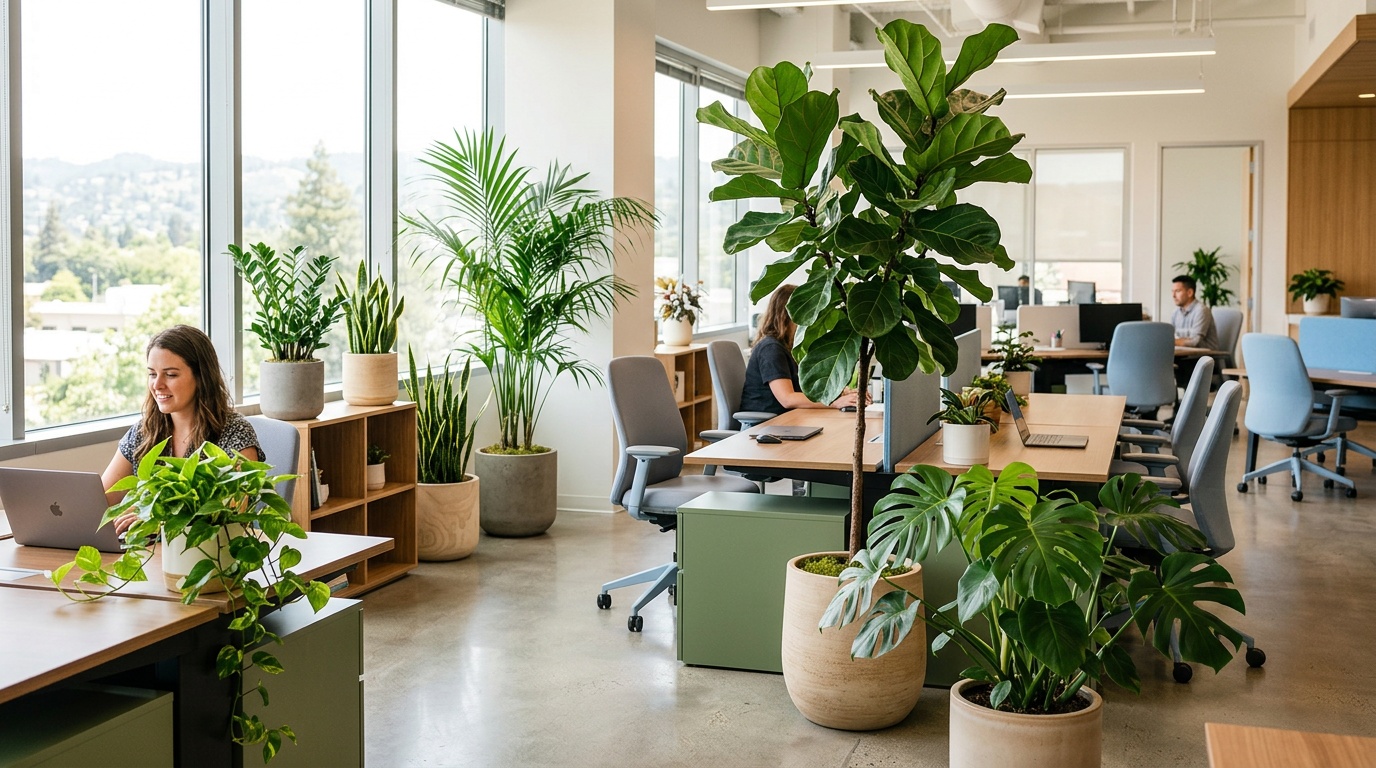
Your free on-site assessment includes a full walkthrough of your facility, natural and artificial light levels, traffic flow, architectural features, HVAC placement, and available floor and desk space. From there, we design a custom proposal with suggested species, containers, placements, and a care plan tailored to your workspace. Every recommendation is grounded in three decades of field data from Northern California commercial installations and peer-reviewed research on biophilic design outcomes.
This service is strictly for businesses and commercial workplaces located within our defined California service area: Berkeley, Brentwood, Burlingame, Concord, Cupertino, Davis, Dublin, Elk Grove, Fairfield, Folsom, Foster City, Emeryville, Fremont, Hayward, Lafayette, Livermore, Martinez, Menlo Park, Milpitas, Mountain View, Newark, Oakland, Orinda, Palo Alto, Pleasant Hill, Pleasanton, Rancho Cordova, Redwood City, Richmond, Roseville, Sacramento, San Carlos, Santa Clara, San Rafael, San Francisco, San Jose, San Mateo, San Ramon, Sunnyvale, Union City, Vacaville, Vallejo, and Walnut Creek.
Frequently Asked Questions
What are the easiest plants to keep alive in an office?
Snake Plants, ZZ Plants, and Cast Iron Plants are among the easiest office plant species to maintain because they tolerate low light and infrequent watering. These species can tolerate up to 2 weeks between waterings and still remain healthy in typical commercial conditions. Office Plants can recommend the right fit after assessing your specific workspace during a complimentary on-site consultation.
Which office plants survive best with no natural light?
ZZ Plants and Cast Iron Plants are known for tolerating very low light conditions, making them strong candidates for interior offices far from windows. Office Plants evaluates each species against the available light during the on-site consultation to confirm suitability for your facility. No plant is guaranteed to thrive without first assessing actual conditions on site.
How often do office plants need watering?
Office Plants’ standard watering guidance uses a 2-week interval, adjusted after assessment for species, light levels, and temperature. Snake Plants typically need water every 2 weeks in standard office settings. A care plan tailored to your selected plants is defined after an on-site assessment of your commercial space.
What plants work well on an office desk?
Snake Plants and Pothos are well suited for desk placement due to their compact or adaptable growth habits. Snake Plants have upright leaves that take up minimal surface area, while Pothos can trail from a small planter. The best choice depends on desk size, lighting, and care availability, all reviewed during your consultation.
Can plants grow in offices with only fluorescent lighting?
Several office plant species, including ZZ Plants and Pothos, can grow under fluorescent lighting with minimal direct sunlight. Office Plants assesses each species against the specific artificial lighting in your facility before making recommendations. Placement flexibility increases when species are matched correctly to the available light conditions in your commercial workspace.
What is the best plant for a busy office with limited maintenance time?
The Cast Iron Plant and ZZ Plant are top choices for busy commercial environments because they tolerate neglect, infrequent watering, and fluctuating temperatures. These species require minimal pruning and are generally pest resistant, reducing replacement costs. Office Plants can confirm which option fits your facility after an on-site evaluation of your space.